
The practice of law, historically tethered to paper, endless hours of review, and repetitive drafting, is undergoing its most significant transformation since the photocopier. The truth is, most legal professionals spend far too much time acting as data entry clerks and not enough time acting as strategic counsel for their clients.
Generative AI is changing that game entirely with advanced Natural Language Processing (NLP) and machine learning. AI solutions are stepping in to automate the exhaustive, low-value work, leading to a profound shift in accuracy, compliance, and the overall efficiency of the legal workflow.
The Problem: Time, Error, and Risk
For legal teams, the core challenges remain time and risk. Every contract, agreement, and compliance document must be drafted, reviewed, and stored under strict standards. This results in:
- HR Time-Sinks: Lawyers and paralegals waste valuable hours on manual data entry, pulling clauses, and ensuring correct formatting.
- Hidden Errors: The human eye is prone to fatigue, making manual review susceptible to typos and overlooked inconsistencies that could lead to disputes or liability.
- Compliance Lag: In fast-moving sectors like finance and real estate, staying current with frequently changing laws is nearly impossible without automated checking.
This drag on efficiency keeps law attorneys from focusing on complex legal judgment, the unique human expertise that truly drives client outcomes.
The Solution: Intelligent Automation with TurfAI
To successfully tackle these challenges, legal teams need AI that is not only fast but also reliable, secure, and easily integrated. This is where TurfAI provides the essential framework for legal document automation:
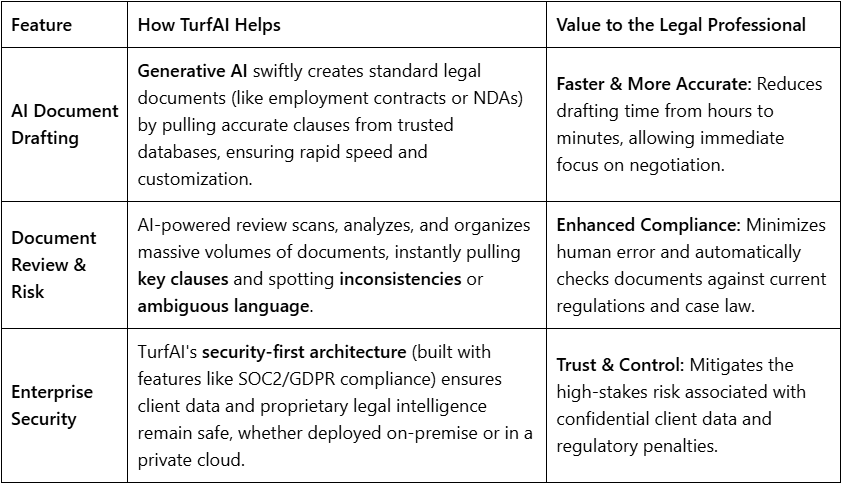
In short, TurfAI takes care of the exhaustive review and drafting “busywork,” allowing legal teams to focus their energy entirely on strategy, client service, and complex problem-solving.
The Future: Augmentation, Not Replacement
The conversation about AI replacing lawyers is misplaced. The reality is that AI is an invaluable supercharged legal assistant. It handles the data-heavy grunt work, the drafting, the searching, the checking, so the human lawyer can dedicate their expertise to:
- Interpreting nuanced legal language.
- Providing ethical counsel and strategic advice.
- Building strong cases based on experience and foresight.
By adopting AI for legal workflows, firms are not sacrificing professional standards; they are augmenting their capabilities to provide faster, more accurate, and ultimately more valuable service to their clients.
The future of legal efficiency is here. See how you can transform your document workflow today.
